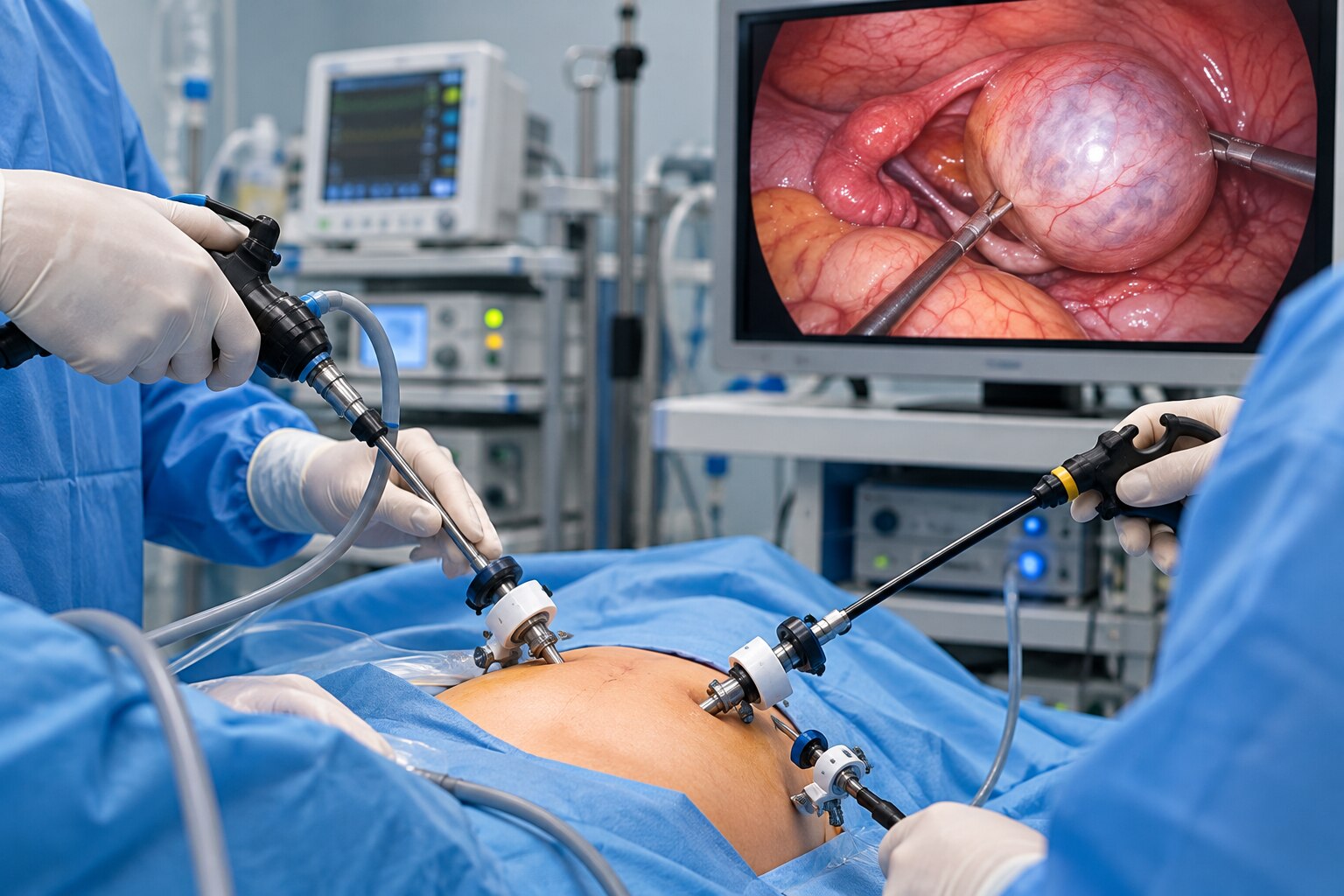
Surgery can remove a cyst that persists, grows, causes pain or looks concerning, but it does not automatically stop the ovary from forming future cysts. By separating functional cysts from endometriomas, dermoid cysts and suspicious ovarian masses, you can understand when monitoring is safer and when surgery deserves discussion.
Key takeaways
- Surgery removes the current cyst, not every future cause of cyst formation.
- Repeat ultrasound helps distinguish a returning cyst from a new or persistent one.
- Ask whether laparoscopic cystectomy can preserve healthy ovarian tissue.
- PCOS-related follicles usually need different management from endometriomas.
Does surgery stop recurrent ovarian cysts from coming back?
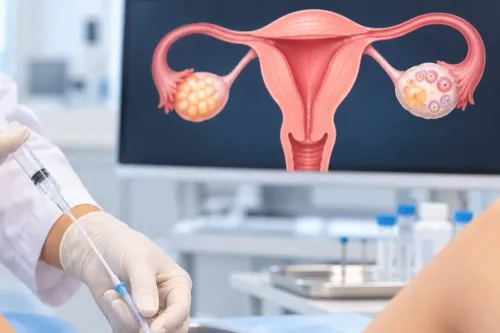
Surgery removes or treats the cyst present during the operation; it does not remove every future cause of cyst formation. Functional follicular cysts and corpus luteum cysts result from ovulation and often disappear over several weeks without surgery.
Operating on every recurrence can expose you to anaesthesia, adhesions and loss of healthy ovarian tissue without preventing the next ovulation-related cyst.
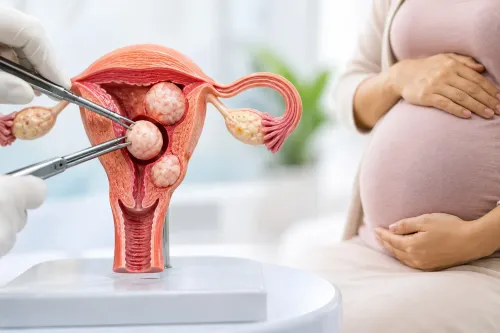
PCOS-related follicles are multiple small follicles linked to ovulatory dysfunction, not automatically one surgical cyst. An endometrioma can return because the underlying endometriosis remains active, while a dermoid cyst develops through a different tissue process.
A cyst associated with torsion, rupture, bleeding or another pelvic condition requires assessment of that cause rather than assuming every recurrence is identical.
The number of previous cysts alone does not establish the need for surgery. The decision in ovarian cyst surgery for recurrent cysts in Navi Mumbai depends on:
- Cyst type and ultrasound appearance
- Pain, bleeding, rupture or torsion risk
- Age and menopausal status
- Whether the cyst persists, enlarges or resolves across menstrual cycles
- Pregnancy plans and the need to protect ovarian tissue
A recurrent, painful, enlarging or suspicious cyst may need removal, but a shrinking, simple functional cyst can often be monitored with repeat ultrasound. Ask what the scan shows and which cause is being treated before assuming surgery will prevent another cyst.
How do doctors confirm that a cyst has returned and decide whether to operate?
Doctors confirm a returned cyst with a transvaginal ultrasound, then compare the new images and report with earlier scans. If pregnancy is possible, a pregnancy test comes first because an ectopic pregnancy can resemble an ovarian problem. Selected blood tests help assess risk when the mass is complex or otherwise concerning.
1. A simple cyst with thin walls, no solid parts and benign-appearing features can be monitored with repeat ultrasound when it is shrinking and symptoms are limited. This avoids operating on a cyst likely to resolve.
2. Surgery becomes more reasonable when the cyst persists across menstrual cycles, enlarges, causes severe or continuing pain, ruptures, bleeds, or creates torsion risk. Solid areas, papillary projections, irregular borders, ascites, suspicious blood flow, or a large or technically concerning mass also shift the balance towards removal.
3. Do not use size alone to decide. The same measurement has different implications before and after menopause; ultrasound appearance, symptoms and fertility plans matter just as much. CA-125 is not a stand-alone cancer test: menstruation, endometriosis and pelvic infection can raise it, while a normal result cannot exclude cancer.
4. Bring earlier scan images and reports, operative or pathology reports, and details of your cycles, pain and pregnancy plans to the consultation. This makes recurrent ovarian cyst treatment in Navi Mumbai specific to your risk rather than based only on the number of previous cysts.
Sudden severe one-sided pain with nausea or vomiting, faintness, fever, abdominal distension or heavy bleeding needs emergency assessment, not a routine appointment.
What type of surgery protects fertility when a recurrent cyst needs removal?
Preserving the ovary is usually the goal. Ovarian cystectomy removes the cyst while retaining ovarian tissue; oophorectomy removes part or all of an ovary. For a benign-appearing mass, fertility-preserving cystectomy is usually preferred when it can be performed safely.
That plan can change if torsion has damaged the ovary, bleeding cannot be controlled, little healthy tissue remains, or the mass strongly suggests malignancy. The operation may then require removal of the ovary or a wider staging procedure.
In surgery for repeated ovarian cysts in Navi Mumbai, ask how the surgeon will protect functioning tissue:
- Separate the cyst from healthy ovarian tissue rather than removing a broad margin.
- Control bleeding with the least damaging method and avoid excessive heat or cautery.
- Remove no more ovarian tissue than the cyst and safety of the operation require.
- Explain whether the procedure is laparoscopic or open and what would make that plan change.
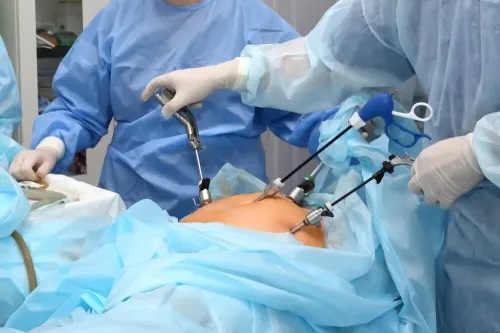
Laparoscopic surgery often suits a benign, manageable mass and usually allows faster recovery. A very large mass, dense adhesions, complications or suspected cancer can require open surgery or referral.
Repeated operations can reduce ovarian reserve, including AMH and the number of eggs available for future fertility treatment. AMH and antral follicle count help frame that discussion; they do not diagnose cancer, prove fertility or make surgery necessary.
Every removed cyst needs histopathological examination. Imaging estimates risk, but tissue diagnosis determines whether you need surveillance or further treatment.
How does treatment differ for functional cysts, endometriomas and PCOS-related findings?
Treatment differs by cyst category: a shrinking simple functional cyst may need repeat ultrasound, while an endometrioma or suspicious mass requires a different risk-and-fertility discussion.
| Type | Usual approach | When surgery enters |
|---|---|---|
| Functional cyst | Observe with repeat ultrasound if it is simple, shrinking and causing limited symptoms. Hormonal contraceptives may reduce new ovulation-related cysts. | A persistent, enlarging, suspicious or acutely painful mass; contraceptives do not dissolve an existing cyst. |
| Endometrioma | Discuss hormonal treatment for pain when pregnancy is not being attempted. | Persistent pain, a sizeable endometrioma, or a need for diagnosis or treatment. Recurrence and reduced ovarian reserve after repeat surgery must be weighed. |
| PCOS-related findings | Manage the underlying PCOS and fertility goals. Multiple small follicles are not automatically surgical cysts. | Surgery is not routine for the ultrasound appearance alone; investigate a separate persistent, enlarging or suspicious mass. |
A recurrent endometrioma is not simply another functional cyst. Surgery can relieve pain or address a sizeable mass, but endometriosis remains capable of producing another endometrioma, and repeat ovarian operations can reduce ovarian reserve.
If you are trying to conceive, ask for ovarian-reserve testing such as AMH and antral follicle count, review both ovaries, and discuss whether fertility treatment should happen before another operation. These tests inform planning; they do not prove fertility or determine surgery alone.
That is why recurrent ovarian cyst treatment in Navi Mumbai needs an individual plan. An ovarian cyst specialist in Navi Mumbai should match the cyst type, scan findings, symptoms and pregnancy plans to observation, medical treatment or surgery.
What should you ask before choosing surgery for repeated cysts in Navi Mumbai?
Do not choose surgery for repeated ovarian cysts in Navi Mumbai until the recommendation can be tested against your records, scan findings and reproductive goals. Bring:
- Earlier ultrasound images and reports, not only the written summary
- Operative and pathology reports from previous procedures
- Menstrual and pregnancy history, pain pattern, medicines and previous pelvic surgery
- Your fertility plans, including whether you are trying to conceive soon
Ask which category the current cyst most resembles and which ultrasound feature supports observation or surgery. Clarify whether the proposed operation is cystectomy or oophorectomy, how much healthy ovarian tissue can be protected, and how the procedure could affect ovarian reserve.
| Option | What it means | Question to settle the choice |
|---|---|---|
| Observation | Repeat ultrasound instead of immediate surgery | When is the next scan, and what change would trigger surgery? |
| Cystectomy | Removes the cyst while retaining the ovary | How will bleeding and healthy tissue be managed? |
| Oophorectomy | Removes part or all of an ovary | Why is preserving the ovary unsafe or unlikely? |
If cancer is suspected, ask whether you need a gynaecologic oncology referral before operating, who will handle unexpected pathology and whether the hospital can coordinate the next step. Parulekar Hospital can be useful when fertility, maternity, gynaecological surgery or neonatal care must be considered together.
A suitable ovarian cyst specialist in Navi Mumbai should give clear risk reasoning, fertility counselling, pathology follow-up and a recurrence plan. Sudden severe one-sided pain, vomiting, faintness, fever, abdominal distension or heavy bleeding needs emergency care.
Related services
Procedures & Surgeries Ovarian cyst surgery is performed to safely remove cysts from the ovary while preserving reproductive health. View service → |
Fertility (IVF / ART) Follicular Monitoring is a simple ultrasound-based procedure used to track the growth and development of ovarian follicles during a menstrual cycle. View service → |
Frequently asked questions
Does surgery stop recurrent ovarian cysts from coming back?
No. Surgery removes or treats the cyst present during the operation. Functional follicular and corpus luteum cysts result from ovulation and often resolve over several weeks without surgery. Recurrence depends on the cyst type and its underlying cause.
How do doctors confirm that an ovarian cyst has returned?
Doctors review symptoms and compare a pelvic ultrasound with earlier scans. They assess the cyst’s size, location, solid areas, septations, blood flow, and whether it has changed over time. Further blood tests or imaging depend on the ultrasound findings and your age.
What type of surgery protects fertility when a recurrent cyst needs removal?
When surgery is appropriate, ask whether laparoscopic ovarian cystectomy can remove the cyst while preserving healthy ovarian tissue. The choice depends on cyst size, appearance, adhesions, previous operations, suspected endometriosis, and the amount of remaining ovary.
How does treatment differ for functional cysts, endometriomas, and PCOS-related findings?
Functional cysts are often monitored with repeat ultrasound because many resolve without surgery. Endometriomas require assessment of pain, size, recurrence, ovarian reserve, and fertility plans before deciding on surgery. PCOS-related small follicles are not the same as a single ovarian cyst and are usually managed through ovulation, metabolic, menstrual, or fertility treatment rather than cyst removal.
What should you ask before choosing surgery for repeated cysts in Navi Mumbai?
Ask what type of cyst is suspected, why surgery is needed now, whether observation is safe, which operation is planned, how much ovarian tissue could be preserved, whether the tissue will undergo histopathology, and how surgery may affect ovarian reserve and future fertility. Ask about the surgeon’s experience, anaesthesia, recovery time, recurrence plan, and emergency contact.
Keywords